
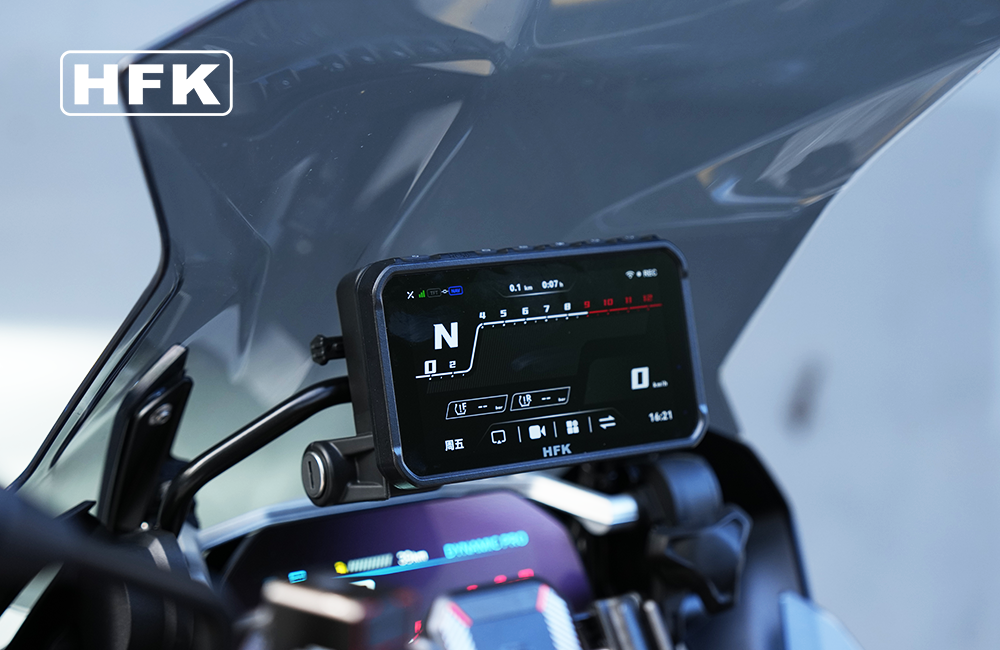

Many riders assume that since Apple CarPlay functions the same on any screen, a car CarPlay system should theoretically work on a motorcycle. From a software perspective, this assumption seems logical. However, from an engineering and environmental standpoint, the two systems are fundamentally different.
The issue is not compatibility — it is design architecture, environmental tolerance, and structural durability.
In this article, we’ll examine the technical differences between automotive CarPlay systems and motorcycle-specific CarPlay units, focusing on mechanical stress, waterproofing standards, thermal management, optical performance, and long-term durability under extreme riding conditions.
1. Environmental Exposure: Controlled Cabin vs Open-Air Operation
Car Environment
Automotive CarPlay systems are installed inside dashboards where they operate in:
-
Enclosed cabin spaces
-
Climate-controlled temperature ranges (typically 18–28°C)
-
Minimal dust exposure
-
Limited UV radiation
-
Reduced mechanical vibration
These systems are designed for stable, predictable operating conditions.
Motorcycle Environment
Motorcycle-mounted electronics operate in:
-
Direct rain and water spray
-
Dust, sand, and mud intrusion
-
Continuous UV exposure
-
Wide temperature swings
-
Sustained mechanical vibration
-
High wind pressure at highway speeds
From an engineering perspective, this is a completely different operating environment category.
2. Waterproof and Ingress Protection Standards
Most automotive CarPlay units do not carry an IP (Ingress Protection) rating because water resistance is not required inside a vehicle cabin.
Motorcycle-specific CarPlay systems typically carry ratings such as:
-
IP67 (dust tight + immersion up to 1m)
-
IP68
-
Or even higher motorcycle-grade sealing standards
Water intrusion is one of the leading causes of electronic failure on motorcycles. Without sealed connectors, gasket protection, and internal waterproof coatings, automotive systems will fail rapidly when exposed to rain or washing.
This is not a feature difference — it is a structural necessity.
3. Vibration and Mechanical Fatigue
Automotive Electronics
Cars provide natural vibration damping through:
-
Suspension systems
-
Engine mounts
-
Chassis insulation
-
Dashboard structural integration
Automotive CarPlay units are mounted within rigid frames that absorb most mechanical stress.
Motorcycle Dynamics
Motorcycles produce significantly higher vibration amplitudes due to:
-
Direct engine vibration
-
Road feedback through forks and handlebars
-
Uneven terrain in ADV riding
-
Long-duration harmonic vibration at cruising RPM
If internal circuit boards, solder joints, and connectors are not reinforced, micro-fractures develop over time. This leads to:
-
Intermittent screen flicker
-
Touch failure
-
Random system resets
-
Complete hardware failure
Motorcycle-specific CarPlay systems are engineered with:
-
Reinforced PCB mounting
-
Shock-absorbing internal structures
-
Vibration-resistant connectors
Without these measures, durability is compromised.
4. Thermal Management and Temperature Range
Automotive CarPlay units operate within temperature-controlled cabins. Thermal fluctuation is limited.
Motorcycles expose electronics to:
-
Direct solar heating (surface temperatures exceeding 60°C)
-
Cold air at highway speeds
-
Rapid temperature transitions at elevation changes
Standard automotive-grade components are not optimized for sustained outdoor heat exposure. Overheating leads to:
-
Screen dimming
-
CPU throttling
-
Wireless instability
-
Long-term component degradation
Motorcycle-specific CarPlay systems utilize:
-
Wider operating temperature components
-
Improved ventilation design
-
UV-resistant materials
-
Heat-tolerant display panels
Thermal resilience directly affects reliability.
5. Optical Engineering: Sunlight Readability
Car interiors reduce glare naturally. Automotive CarPlay screens are calibrated for indoor viewing.
On a motorcycle, direct sunlight creates:
-
High glare reflection
-
Reduced contrast
-
Visual washout
Outdoor motorcycle CarPlay systems use:
-
High-nit brightness displays
-
Anti-glare coatings
-
Optical bonding to reduce internal reflection
Visibility is a safety factor, not a convenience feature.
6. Mounting Architecture and Wind Load
Car CarPlay systems are integrated into dashboards and do not experience wind load.
Motorcycle-mounted systems must withstand:
-
Continuous wind pressure at 100+ km/h
-
Aerodynamic turbulence
-
Mechanical oscillation
Mount design and structural rigidity determine whether the system remains stable. Automotive units lack this consideration entirely.
7. Durability Over Time: Short-Term Function vs Long-Term Reliability
An automotive CarPlay unit might technically function when temporarily mounted on a motorcycle. However, the issue is cumulative stress.
Repeated exposure to:
-
Water ingress
-
Vibration cycles
-
UV radiation
-
Thermal expansion and contraction
will gradually degrade non-motorcycle-grade electronics.
Motorcycle-specific CarPlay systems are designed for:
-
Long service life
-
Outdoor endurance
-
Mechanical resilience
-
Consistent wireless stability
Durability is not about surviving one ride — it is about surviving years of riding.
Conclusion: The Engineering Gap Is Structural, Not Cosmetic
Car CarPlay systems and motorcycle-specific CarPlay systems may run the same software interface, but they are built for entirely different environmental categories.
From a technical standpoint, automotive CarPlay systems lack:
-
Ingress protection
-
Vibration reinforcement
-
Outdoor optical optimization
-
Wide thermal tolerance
-
Structural mounting integrity
Motorcycle-specific CarPlay systems are engineered to address each of these challenges directly.
Attempting to use a car CarPlay system on a motorcycle is not simply an adaptation — it is placing electronics outside their designed operating parameters.
For riders who value safety, stability, and long-term reliability, the choice is not about brand — it is about engineering suitability.
On a motorcycle, durability is not optional.
It is a design requirement.
Share:
Why Most Motorcycle CarPlay Systems Fail on BMW ADV Long-Distance Trips — And How to Choose the Right One
Thinking About Installing a Motorcycle CarPlay but Not Sure How to Choose? A Technical Comparison Guide with Real Specifications