

Long-distance motorcycle touring represents freedom — the freedom to explore, to ride beyond familiar roads, and to experience the world in its rawest form.
But with that freedom comes a reality every rider must face:
The further you ride, the less control you have over the environment.
Unfamiliar roads, unpredictable drivers, sudden weather changes — all of these increase the risk of accidents. And when something goes wrong far from home, the challenge is not just the accident itself, but how you protect yourself afterward.
1. The Hidden Risk of Long-Distance Riding
On long journeys, riders often face:
- Fatigue after hours of riding
- Complex road conditions in unfamiliar regions
- Limited traffic monitoring in remote areas
- Lack of witnesses in case of incidents
Unlike urban environments, where cameras and bystanders are common, many touring routes offer no external evidence at all.
Which leads to a critical problem:
If an accident happens, how do you prove what really occurred?
2. Evidence Is Your Strongest Protection
In motorcycle accidents, riders are often at a disadvantage.
Without clear evidence:
- Fault can be misjudged
- Drivers may deny responsibility
- Insurance claims may be delayed or rejected
With proper recording:
- The entire incident is documented
- Road conditions are visible
- Vehicle behavior is clearly captured
This is why more experienced touring riders consider a motorcycle dash cam not optional — but essential.
3. Why a Smart Riding System Matters
Modern long-distance riding is no longer just about mechanical reliability. It is about information and awareness.
A smart riding setup typically includes:
- A CarPlay system for navigation and control
- A dash cam system for continuous recording
This combination ensures protection both before and after an incident.
4. CarPlay: Preventing Accidents Before They Happen
One of the biggest risks in long-distance riding is distraction.
Checking a phone for navigation may seem simple — but at highway speeds, even a second of distraction can be dangerous.
A dedicated motorcycle CarPlay system solves this by:
- Displaying navigation at eye level
- Providing real-time route updates
- Supporting voice control for hands-free operation
- Allowing seamless access to calls and music
This keeps riders focused on the road — where their attention should be.
5. Dash Cam: Your Silent Witness After an Accident
If prevention fails, documentation becomes everything.
A motorcycle dash cam records:
- Front road conditions
- Rear traffic behavior
- Unexpected hazards
In the event of an accident, this footage can:
- Prove your position and actions
- Clarify responsibility
- Support insurance claims
- Protect you from false accusations
For long-distance riders, especially in remote areas, this is often the only reliable evidence available.
6. A Practical Solution: Integrated CarPlay + Dash Cam System
Instead of using separate devices, many riders are now choosing integrated systems that combine both navigation and recording.
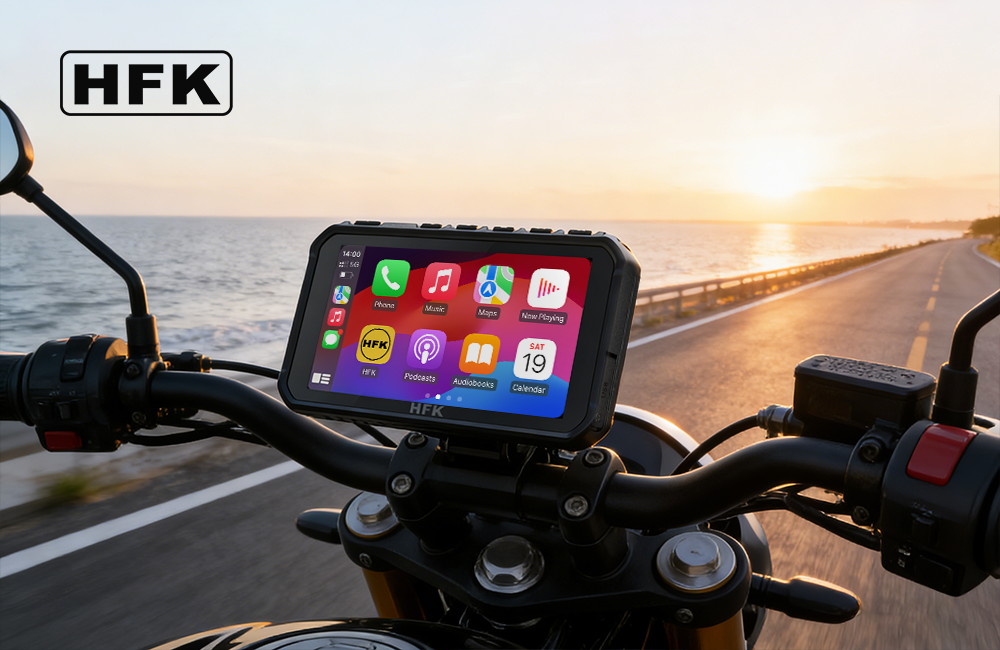
This is where solutions like the HFK HC50 stand out.
Designed specifically for motorcycle use — especially long-distance and ADV touring — it brings together both essential functions into a single, stable platform.
Why this matters in real riding scenarios:
-
Integrated CarPlay interface
Keeps navigation visible and accessible without distractions -
Front and rear recording system
Ensures full coverage in case of incidents -
High-bright display for outdoor visibility
Remains clear under strong sunlight during long rides -
Rugged waterproof construction (built for extreme conditions)
Handles rain, dust, and harsh environments with confidence -
Vibration-resistant design
Maintains stable performance even on rough terrain
In other words, it is not just a gadget — it is part of a complete riding safety system.
7. Real-World Scenario: Why It Matters
Imagine this:
You’re riding through a remote mountain road.
A car suddenly brakes ahead.
You react quickly, but a vehicle behind you fails to stop in time.
There are no cameras.
No witnesses.
No clear way to prove what happened.
Now compare two situations:
Without recording:
- It becomes your word against theirs
- Insurance claims become complicated
- Responsibility may be unclear
With a system like HC50:
- The entire sequence is recorded
- The rear camera shows the approaching vehicle
- The front camera shows your response
- The situation becomes clear and objective
That difference is not small.
It can determine the outcome of the entire situation.
8. Confidence Changes the Riding Experience
There is also something less obvious — but equally important:
Confidence.
Knowing that:
- Your navigation is stable
- Your ride is being recorded
- Your setup is reliable
…allows you to focus on the journey instead of worrying about the unknown.
And in long-distance touring, mental clarity is just as important as physical safety.
Conclusion
Accidents are unpredictable — especially on long-distance motorcycle journeys.
But being unprepared is avoidable.
Protecting yourself is not just about gear.
It is about having the right system in place.
A motorcycle CarPlay system helps you stay focused and navigate safely.
A dash cam ensures that if something goes wrong, you are protected with evidence.
An integrated solution like the HFK HC50 brings both together — combining convenience, safety, and reliability into one platform designed for real-world riding.
Because when you are far from home, you don’t just need performance.
You need protection you can rely on.
Share:
What Should the Best Motorcycle CarPlay for Long-Distance Touring Have? A Technical Comparison Guide
Why the HC50 Is the Motorcycle CarPlay System That Truly Understands Riders (With Real Technical Comparison)