

Whether you ride a motorcycle every day, enjoy weekend road trips, or travel long distances across different countries, safety should always come first. Motorcycles offer freedom and excitement, but riders are also more exposed to traffic, road conditions, and unexpected situations.
A motorcycle dashcam is a practical tool that helps document what happens during every ride. It continuously records the road, saves important video footage, and allows riders to review events when necessary. But have you ever wondered how a motorcycle dashcam actually works?
Unlike a regular camera, a dedicated motorcycle dashcam is designed to operate in a demanding outdoor environment. It needs to handle vibration, rain, dust, temperature changes, and continuous movement while keeping important recordings safe.
In this complete guide, we will explain how motorcycle dashcams work, what their main components do, which features matter most, and how to choose the right system for your motorcycle.
1. What Is a Motorcycle Dashcam?
A motorcycle dashcam is a video recording system designed specifically for motorcycles. Its main purpose is to record the road and surrounding traffic while you ride.
Most dedicated motorcycle dashcams include one or two cameras connected to a recording unit or display. The cameras capture video, while the system processes and saves the footage to internal storage or a memory card.
Unlike a traditional action camera, which is often used to record selected riding moments, a motorcycle dashcam is generally designed for continuous recording. Many systems can start recording automatically when the motorcycle is powered on, so riders do not need to remember to press a button before every journey.
Depending on the model, a motorcycle dashcam may offer:
-
Front and rear video recording
-
Automatic startup and continuous recording
-
Loop recording
-
Collision detection and emergency video protection
-
GPS positioning and speed information
-
Wi-Fi or smartphone app connectivity
-
Waterproof and dust-resistant construction
-
Night recording and wide-angle lenses
Not every model includes all these features. However, they work together to make a dedicated motorcycle recording system more practical for everyday riding.
2. How Does a Motorcycle Dashcam Work?
The working process is relatively simple. A motorcycle dashcam captures video through its camera lenses, processes the images, and stores the recordings for later viewing.
Here is how the system usually works.
Step 1: The System Receives Power
Most permanently installed motorcycle dashcams connect to the motorcycle's electrical system.
When the rider turns on the ignition, the system receives power and starts automatically. Depending on the model and its settings, recording begins shortly after startup.
Some systems use a dedicated power cable connected to the motorcycle battery and an ignition-switched power source. This allows the device to operate with the motorcycle and helps avoid relying on a small built-in battery.
Portable cameras work differently. They usually depend on their own rechargeable batteries or an external power bank, which means riders may need to check battery levels and start recording manually.
For everyday use, automatic power-on and recording are valuable features. You can focus on riding without worrying about whether you remembered to turn on your camera.
Step 2: The Cameras Capture the Road
Once the system starts, the camera sensors capture light through the lenses and convert it into digital video.
A single-camera system records one direction, usually the road ahead. A dual-camera system uses two separate cameras to record both the front and rear of the motorcycle.
Front and rear recording provides a more complete view of traffic conditions.
For example:
-
The front camera can capture vehicles approaching from the opposite direction, traffic lights, intersections, and sudden lane changes.
-
The rear camera can record tailgating, rear-end collisions, and vehicles approaching from behind.
Some systems also use wide-angle lenses to capture more of the surrounding road. However, a wider viewing angle does not automatically mean better footage. Lens quality, sensor performance, image processing, and camera positioning all affect the final result.
Step 3: The System Processes the Video
After capturing the images, the dashcam processes the video and prepares it for storage.
Video resolution determines the amount of image detail recorded. Common options include Full HD 1080P, 2K, and 4K.
Higher resolution can provide more detail when reviewing important moments, such as vehicle movements or road signs. However, it also requires more storage space and sufficient processing performance.
Frame rate is another important factor. A higher frame rate can make fast-moving scenes appear smoother, although clear footage also depends on lighting, shutter speed, and sensor quality.
For motorcycle riders, the goal is not simply to choose the highest resolution number. It is to find a balanced system that produces clear and reliable footage under real riding conditions.
Step 4: Video Footage Is Saved Automatically
Most dedicated motorcycle dashcams save video in short recording segments instead of creating one extremely long video file.
This process is called loop recording.
When the storage space becomes full, the system automatically overwrites the oldest unprotected video files with new recordings. This allows the camera to continue recording without requiring riders to delete old videos manually.
For example, imagine that your motorcycle dashcam records your daily commute. After several rides, the storage becomes full. Instead of stopping the recording process, loop recording makes room for new footage by replacing older files.
This is especially useful for riders who use their motorcycles frequently.
However, loop recording does not mean every video is permanently saved. If a recording contains an important event, it should be protected or copied to another device before it is overwritten.
3. What Happens When a Motorcycle Accident Occurs?
One of the most important reasons to install a motorcycle dashcam is to preserve video evidence when an unexpected incident happens.
Many dedicated systems include a feature called a G-sensor, also known as a gravity sensor.
The G-sensor detects sudden changes in movement, such as a strong impact or rapid deceleration. When the sensor detects an event that meets the configured sensitivity level, the dashcam may automatically lock the current recording.
A locked video is protected from normal loop recording, helping prevent important footage from being overwritten.
For example, if another vehicle suddenly hits your motorcycle, the G-sensor may detect the impact and protect the relevant video segment.
Some systems also provide manual emergency recording, allowing riders to protect footage when they notice a dangerous situation.
It is important to understand that G-sensor performance depends on its sensitivity settings and the type of impact. Very low sensitivity may fail to detect some events, while very high sensitivity may lock videos whenever the motorcycle passes over a pothole or rough road.
A good system should provide suitable sensitivity settings for different riding conditions.
4. What Are the Main Components of a Motorcycle Dashcam?
Understanding the main components makes it easier to choose a reliable recording system.
| Component | Main Function | Why It Matters |
|---|---|---|
| Front camera | Records the road ahead | Captures traffic and road incidents |
| Rear camera | Records traffic behind | Documents rear-end incidents and tailgating |
| Main recording unit | Processes and manages video | Controls recording and storage |
| Power cable | Supplies electrical power | Supports continuous operation |
| Storage | Saves recorded footage | Keeps videos available for review |
| GPS module | Records location information | Helps identify where a recording took place |
| Mounting brackets | Secure the cameras | Keep the recording angle stable |
Some modern systems combine the recording unit and display into one device. This reduces the number of separate components riders need to install and provides a convenient way to access navigation and camera functions.
5. What Additional Features Make a Motorcycle Dashcam More Useful?
A basic camera can record video, but advanced features make a motorcycle dashcam much more practical.
5.1 GPS Positioning
GPS allows a dashcam to record location information during a ride. Depending on the system, it may also record speed, date, and time.
When reviewing footage, GPS information can help riders understand where an incident occurred and provide additional context about the journey.
Some advanced systems support multiple satellite positioning systems, such as GPS and BeiDou (BDS), to improve positioning capabilities.
However, GPS recording and smartphone navigation are two different functions. A dashcam may record location information without providing navigation on its own.
5.2 Smartphone Connectivity
Many motorcycle dashcams support Wi-Fi or a dedicated mobile application.
This allows riders to connect their smartphones to the camera system and perform tasks such as:
-
Previewing camera footage
-
Checking recording status
-
Adjusting camera settings
-
Downloading video clips
-
Reviewing recorded journeys
Smartphone connectivity is convenient, but it does not necessarily mean that the dashcam requires a phone to record. Many dedicated systems can continue recording independently once they are powered on and configured.
5.3 Night Vision and Low-Light Recording
Motorcycle riders often travel at night or through poorly lit areas. A camera with good low-light performance can help capture more useful details in these conditions.
Image sensors, lens quality, exposure control, and image processing all influence night recording.
Some systems use advanced image sensors and HDR technology to improve visibility in challenging lighting conditions.
However, night vision does not guarantee that every license plate or distant object will be clearly visible. Riders should check real-world sample footage rather than relying only on marketing descriptions.
5.4 Waterproof and Dust-Resistant Design
Unlike car dashcams, motorcycle cameras are often exposed directly to rain, dust, mud, and road spray.
A motorcycle-specific dashcam should have suitable environmental protection for outdoor use.
For example, an IP69K-rated product is designed to withstand demanding dust and high-pressure, high-temperature water-jet testing under the applicable test conditions. This is different from simply being splash-resistant.
Environmental protection is especially important for riders who travel in changing weather or regularly ride on long-distance routes.
5.5 Vibration and Shock Resistance
Motorcycles generate continuous vibration from the engine, road surface, and suspension.
A camera designed for motorcycle use should have a durable housing, secure internal construction, and reliable mounting accessories.
A stable installation helps keep the camera pointed in the correct direction and reduces unwanted movement in recorded footage.
Remember that electronic image stabilization and physical vibration resistance are different. Image stabilization helps smooth the video, while a strong structure and secure mount help protect the camera and maintain its position.
6. Motorcycle Dashcam vs. Action Camera: What Is the Difference?
Many riders use action cameras to record their motorcycle journeys. While both devices can capture video, they are designed for different purposes.
| Feature | Motorcycle Dashcam | Action Camera |
|---|---|---|
| Main purpose | Continuous road recording | Capturing selected videos |
| Automatic startup | Common on hardwired systems | Depends on model and settings |
| Loop recording | Common | Model-dependent |
| Front and rear coverage | Available on dual-camera systems | Usually requires additional equipment |
| Power source | Often connected to motorcycle power | Usually rechargeable battery |
| Everyday recording | Designed for regular use | Requires more manual management |
| Motorcycle installation | Dedicated mounting and wiring options | Often uses action-camera mounts |
An action camera is a great choice for motorcycle vlogs, scenic videos, and recording memorable riding experiences.
A dedicated motorcycle dashcam is usually more suitable when the main goal is continuous road recording and keeping evidence of unexpected incidents.
Some riders choose to use both: a dashcam for everyday protection and an action camera for creative video recording.
7. How to Install and Maintain a Motorcycle Dashcam
Correct installation is essential for reliable recording. Even an advanced camera cannot perform properly if it is mounted incorrectly or connected to an unsuitable power source.
Here are some basic installation considerations.
Choose the right camera position.
The front camera should have a clear view of the road without being blocked by the windshield, fairing, or other motorcycle parts. The rear camera should capture traffic behind the motorcycle.
Secure the mounting brackets.
Use compatible mounting hardware and make sure the cameras cannot move easily. Avoid mounting locations that experience excessive movement or interfere with motorcycle controls.
Connect the power correctly.
Follow the manufacturer's wiring instructions. For hardwired systems, use the recommended power connections and protective components. If you are unfamiliar with motorcycle electrical systems, consider professional installation.
Protect the cables.
Keep cables away from hot engine parts, sharp edges, and moving components such as the steering and suspension. Secure loose wiring to prevent damage during riding.
Check the storage regularly.
Make sure the system recognizes its storage device and that recordings are being saved correctly. Use a compatible memory card or the manufacturer's recommended storage solution.
Review test footage.
After installation, take a short test ride and check the front and rear recordings. Confirm that the camera angles are correct and that there are no unexpected recording interruptions.
Regular checks can help identify loose mounts, damaged cables, or storage problems before they affect an important recording.
8. Why Should Every Motorcycle Rider Consider a Dedicated Dashcam?
Motorcycle riders face risks that drivers inside cars may not experience in the same way. They have less physical protection, are more exposed to weather, and can be harder for other road users to notice.
A motorcycle dashcam cannot prevent every accident, but it can provide a record of what happened.
Here are some practical benefits:
Accident documentation: Video footage can help explain the sequence of events after a collision.
Protection against false claims: Recordings may help clarify traffic disputes and provide supporting information when accounts of an incident differ.
Rear-end incident recording: A rear camera can capture situations that a front-facing camera would miss.
Daily riding records: Riders can review routes, traffic conditions, and interesting moments from their journeys.
Peace of mind: Automatic recording means riders do not need to remember to start a camera before every trip.
Of course, footage does not automatically determine legal responsibility or guarantee an insurance outcome. Its value depends on recording quality, camera angle, available evidence, and local requirements.
Still, having a reliable recording system can make a meaningful difference when an unexpected situation occurs.
9. Discover HFK Motorcycle Recording Solutions
For riders who want more than a basic camera, HFK combines motorcycle recording technology with practical features designed for everyday riding.
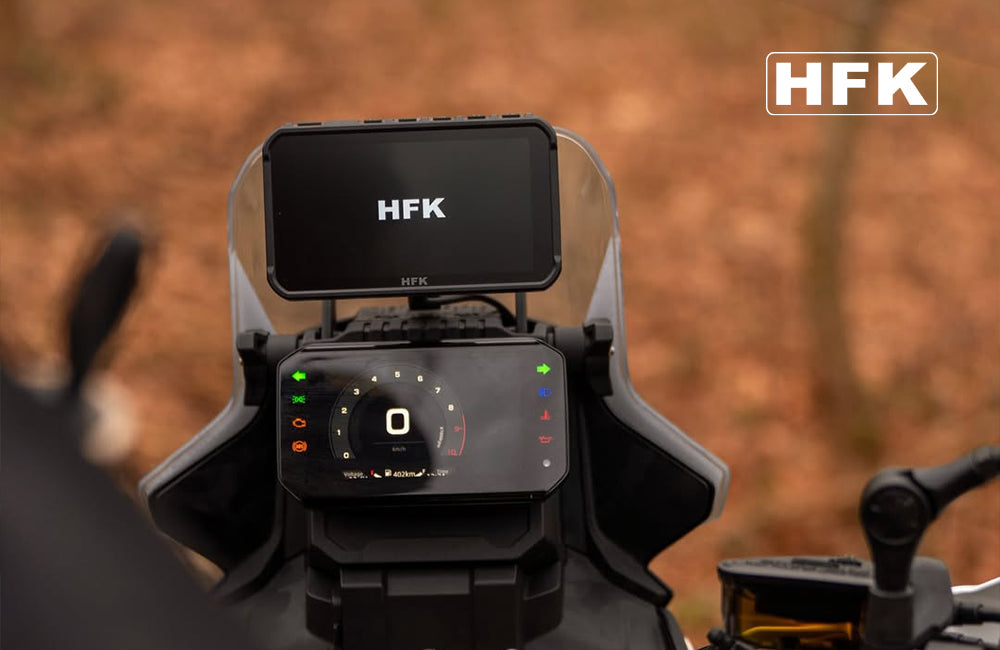
The HFK HC50 is a motorcycle CarPlay system with front and rear 2K cameras. It supports continuous loop recording and built-in storage, helping riders record their journeys without needing to manage a separate action camera. Its IP69K-rated design provides strong environmental protection for demanding motorcycle use.
The HFK HC50-RM offers a quick-release motorcycle CarPlay display with a reinforced aluminum body and GPS positioning capabilities. Riders can remove and attach the display conveniently when switching between compatible motorcycles. It also supports optional front and rear cameras, allowing users to add recording functionality according to their needs.
Please note that cameras are included with the HC50, while the standard HC50-RM package does not include cameras. They must be purchased separately.
Explore the products here:
Whether you ride through busy city streets or explore open roads on a long-distance tour, HFK aims to make every journey more connected and better protected.
10. Final Thoughts
So, how does a motorcycle dashcam work?
It uses one or more cameras to capture the road, processes the video, and saves recordings to storage. Features such as automatic startup, loop recording, G-sensor protection, GPS, and smartphone connectivity make the system more convenient and useful.
However, choosing a motorcycle dashcam is not just about video resolution or the number of features. Riders should also consider durability, waterproof protection, vibration resistance, mounting stability, storage reliability, and ease of use.
A dedicated motorcycle dashcam is designed to handle the challenges of riding while providing continuous road documentation. It is more than an accessory for recording beautiful journeys. It is a practical tool that helps protect your riding experience when the unexpected happens.
Enjoy the freedom of riding. Let HFK help protect every free road.
Share:
Do Motorcycle Dashcams Have GPS? Everything Riders Need to Know