
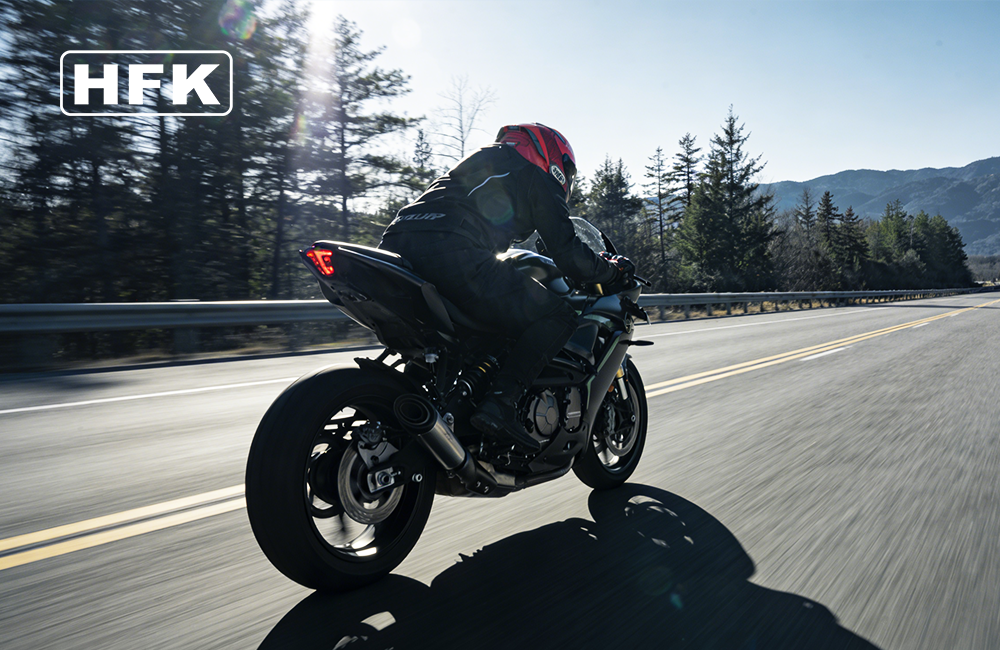

When riders think about motorcycle safety equipment, the first things that usually come to mind are helmets, riding jackets, gloves, boots, and protective gear.
But there is another piece of equipment that is becoming increasingly important:
The motorcycle dash cam.
At first glance, a dash cam may seem like just another electronic accessory. After all, why not simply use an action camera?
The answer becomes clear when you consider what a motorcycle dash cam is actually designed to do.
An action camera is primarily designed to capture your adventure.
A motorcycle dash cam is designed to protect your ride.
That difference can become extremely important when something unexpected happens.
More Than Just Recording Your Ride
A motorcycle dash cam continuously records what happens around you while you ride.
Unlike a camera that you have to remember to turn on, position, and manage before every trip, a dedicated dash cam can become part of the motorcycle itself.
This means riders can focus on riding instead of worrying about recording.
Depending on the system, useful features can include:
- Front and rear recording
- Continuous loop recording
- Automatic video storage
- GPS information
- Wide-angle coverage
- High-resolution video
- Night recording
- Vibration-resistant design
Together, these features turn the dash cam into a practical riding safety system rather than simply a video camera.
Why Accident Evidence Matters
Motorcycle accidents can happen in seconds.
A vehicle may suddenly change lanes. A driver may run a red light. Someone may open a car door unexpectedly. Road debris can appear without warning.
After an accident, the biggest problem is often not knowing what happened.
There may be:
- Conflicting statements
- Limited witnesses
- Unclear road conditions
- Difficult-to-prove traffic violations
A dash cam provides something extremely valuable:
A record of what actually happened.
Video footage can help riders better understand an incident and may provide useful evidence for insurance claims or disputes, subject to local laws and policies.
For a motorcycle rider, this can provide an additional layer of protection that protective gear alone cannot offer.
Why Front and Rear Cameras Are Better
A single camera only sees one direction.
But motorcycles are surrounded by traffic.
Danger can come from:
- Behind
- Beside you
- In front of you
- At intersections
This is why front-and-rear motorcycle dash cameras can provide a much more complete view.
The front camera can capture:
- Vehicles ahead
- Traffic lights
- Road conditions
- Sudden obstacles
The rear camera can capture:
- Following vehicles
- Rear-end incidents
- Unsafe overtaking
- Vehicles approaching from behind
For daily commuting and long-distance touring alike, having both perspectives can make a major difference.
Dash Cam vs. Action Camera: What's the Difference?
Many riders already own an action camera, so it is natural to ask:
Why buy a motorcycle dash cam?
The two products serve different purposes.
| Feature | Motorcycle Dash Cam | Action Camera |
|---|---|---|
| Primary Purpose | Riding safety & evidence | Adventure & content |
| Continuous Recording | Usually designed for it | Often requires manual operation |
| Front & Rear Coverage | Available on many systems | Usually single camera |
| Loop Recording | Common | Less focused on continuous recording |
| Automatic Operation | Designed for motorcycle use | Usually rider-controlled |
| Accident Evidence | Strong focus | Secondary purpose |
| Installation | Integrated with motorcycle | Flexible mounting |
| Riding Footage | Practical | Creative / cinematic |
An action camera is excellent when you want to create exciting riding videos.
A dash cam is better when you want continuous protection without having to think about the camera.
In other words:
An action camera records your adventures. A dash cam records your reality.
Security Doesn't Stop When You Leave the Bike
Another advantage that many riders overlook is security.
A motorcycle can be vulnerable when parked:
- At a hotel
- Outside a restaurant
- On the street
- At a campsite
- During long-distance travel
Depending on the product and installation, certain motorcycle recording systems can support parking-monitoring or security-related functions.
This can help riders keep a closer eye on their motorcycle when they are away from it.
A dash cam therefore has the potential to serve two roles:
Protection while riding and additional awareness while parked.
The exact parking-security functions depend on the specific system, so riders should check the manufacturer's specifications before purchasing.
Why Durability Matters on a Motorcycle
A motorcycle dash cam operates in a much harsher environment than a camera sitting inside a car.
It may be exposed to:
- Constant vibration
- Heavy rain
- Dust
- Mud
- Direct sunlight
- High temperatures
- Cold weather
- Rough roads
This is why choosing a motorcycle-specific dash cam matters.
A good system should be designed around the realities of motorcycle riding, including weather resistance, vibration protection, reliable power connections, and stable long-term operation.
For adventure and long-distance riders, durability is especially important.
A device that works perfectly on a short sunny ride is not necessarily suitable for a multi-day journey through rain, heat, and rough terrain.
High-Quality Video Is About More Than Resolution
Many riders look only at the number of pixels when comparing dash cams.
But resolution is only one part of the equation.
Important factors also include:
Image Sensor
A quality sensor can improve detail and visibility, especially in challenging lighting conditions.
HDR
HDR technology can help preserve useful details when there is a large difference between bright and dark areas.
Night Vision
A motorcycle doesn't stop riding when the sun goes down. Good low-light performance is essential for night touring and commuting.
Image Stabilization
Motorcycles constantly experience vibration. Stable footage is much easier to review and can provide clearer information after an incident.
Loop Recording Makes Everyday Use Easier
Imagine recording a six-hour motorcycle trip.
Do you really want to manually manage every video file?
Probably not.
Loop recording is designed to solve this problem.
When storage becomes full, older footage can be automatically overwritten while important recordings can be preserved, depending on the system.
This allows the dash cam to function quietly in the background.
You simply ride.
The camera keeps recording.
And if something important happens, the footage is already there.
GPS Adds Another Layer of Information
Some motorcycle dash cams can also record GPS information.
This can provide additional context such as:
- Riding location
- Route information
- Travel history
- Approximate speed or movement data, depending on the system
For long-distance riders, this can also turn the dash cam into a useful travel record.
You don't just remember where you went.
You can preserve part of the journey digitally.
Why Dash Cams Are Especially Valuable for Long-Distance Riders
The longer you ride, the more unpredictable situations you encounter.
A short commute may be familiar.
A 2,000-mile motorcycle trip is completely different.
Long-distance riders may encounter:
- Unfamiliar traffic rules
- Different road conditions
- Heavy highway traffic
- Extreme weather
- Remote areas
- Unexpected road hazards
In these situations, a dash cam becomes an additional layer of confidence.
It doesn't prevent every accident.
It doesn't replace protective equipment.
And it doesn't make a rider invincible.
But it can provide something extremely valuable:
Evidence, awareness, and peace of mind.
The Smartest Motorcycle Setup Combines Navigation and Recording
Modern motorcycle technology is moving beyond individual devices.
A smart motorcycle CarPlay system can provide:
- Navigation
- Phone integration
- Music
- Calls
- Voice assistance
A motorcycle dash cam can provide:
- Front and rear recording
- Accident evidence
- Continuous recording
- Travel documentation
Together, they create a much more complete riding ecosystem.
Instead of mounting a phone, an action camera, and multiple separate accessories, riders can build a more integrated setup around the motorcycle itself.
The result is not simply more technology.
It is less distraction and more confidence.
So, Does Your Motorcycle Really Need a Dash Cam?
If you only ride occasionally on quiet roads, you may see a dash cam as an optional accessory.
But for daily commuters, ADV riders, touring enthusiasts, and long-distance travelers, its value becomes much clearer.
A dedicated motorcycle dash cam can help provide:
Safety: Continuous recording when unexpected situations occur.
Protection: Useful visual evidence after an accident or traffic dispute.
Convenience: Automatic recording without constantly managing a camera.
Security: Additional monitoring possibilities when the motorcycle is parked, depending on the system.
Adventure: A permanent record of the roads, landscapes, and journeys you experience.
The biggest advantage is simple:
You don't have to think about it.
Put on your helmet. Start the motorcycle. Ride.
The dash cam quietly does its job in the background.
An action camera may capture the most exciting moments of your journey.
But a dedicated motorcycle dash cam is there for the moments you never planned to capture.
And sometimes, those are the moments that define the difference between uncertainty and clarity, between doubt and proof, between risk and reassurance.
Because in the end, riding is not only about enjoying the road ahead—it is also about being prepared for everything that might happen on it.
Share:
So Many Motorcycle CarPlay Brands—How Do You Choose the Right One?
Can a Motorcycle CarPlay Display Also Work as a Dashcam?